Mohamed Fathi Abdallah

AU FOOD TOX Research Group

Advancing food toxicology through cutting-edge research on natural toxins, emerging contaminants, and mixture risk assessment.

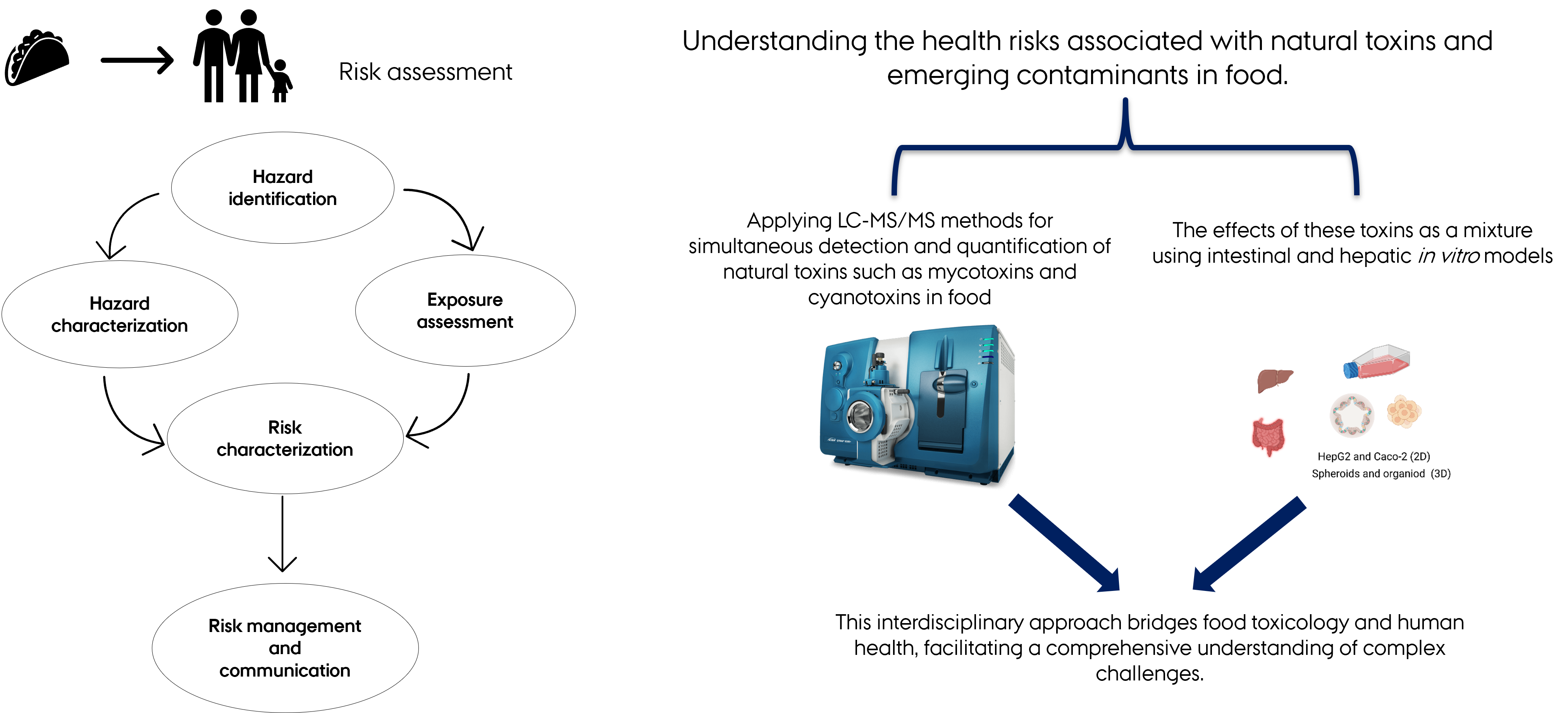
At AU FOOD Department, our research is centered on understanding the risks associated with natural toxins (mycotoxins and cyanotoxins) and other emerging contaminants in novel food. This is done by applying LC-MS/MS methods for detection. Also, through the use of in vitro models, we investigate the effects of these toxins as mixtures on human health. This interdisciplinary approach bridges food toxicology and human health, facilitating a comprehensive understanding of complex challenges.

For more details about cv visit this link : https://www.mfathiabdallah.com/CV/

AU FOOD TOX
A schematic overview of AU FOOD TOX group's research focus.

➤ Research Lines

A) Natural Toxins in Food

Detection and occurrence of mycotoxins and cyanotoxins in food products using LC-MS/MS and targeted/non-targeted analysis.

Related publications:

  • WR Van Hassel, MF Abdallah, MG Velasquez, C Miles, I Samdal, J Masquelier, A Rajkovic (2024). Experimental accumulation and depuration kinetics and natural occurrence of microcystin-LR in basil (Ocimum basilicum L.). Environmental Pollution, 123715. [Link]
  • C Van Camp, W Van Hassel, MF Abdallah, J Masquelier (2023). Simultaneous detection and quantification of aflatoxin M1, eight microcystin congeners and nodularin in dairy milk by LC-MS/MS. Chemosensors, 11(10), 511. (Open Access) [Link] [Download PDF]
  • L De Colli, K De Ruyck, MF Abdallah, J Finnan, E Mullins, S Kildea, J Spink, C Elliott, M Danaher (2021). Natural co-occurrence of multiple mycotoxins in unprocessed oats grown in Ireland with various production systems. Toxins, 13(3), 188. (Open Access) [Link] [Download PDF]
  • MF Abdallah*, K Audenaert, L Lust, S Landschoot, B Bekaert, G Haesaert, M De Boevre, S De Saeger (2020). Risk characterization and quantification of mycotoxins and their producing fungi in sugarcane juice. Food Control, 108, 106811. [Link]
  • MF Abdallah, G Girgin, T Baydar, R Krska, M Sulyok (2017). Occurrence of multiple mycotoxins and other fungal metabolites in animal feed and maize samples from Egypt using LC-MS/MS. Journal of the Science of Food and Agriculture, 97(13), 4419–4428. [Link]
  • MF Abdallah, R Krska, M Sulyok (2016). Mycotoxin contamination in sugarcane grass and juice: first report on detection of multiple mycotoxins and exposure assessment for aflatoxins B1 and G1 in humans. Toxins, 8(11), 343. (Open Access) [Link] [Download PDF]

B) Mixture Toxicology, Risk Assessment & Human Health

Investigating combined toxic effects of multiple food contaminants using in vitro models and New Approach Methodologies (NAMs).

Related publications:

  • M Suman, M Oboeuf, MF Abdallah, C Hazel, E Varga, A Mally, A Medina, M Molero, A Sansom, KJ Korzeniowski (2025). Framework on risk prioritisation of mycotoxins in food: a case study in two wheat-based products. World Mycotoxin Journal. [Link]
  • C Dongye, X Chen, Y Zhao, H Li, MF Abdallah, T Li, X Chen (2025). Protective effects of octyl gallate against deoxynivalenol-induced colon inflammation: insights from proteomic and metabolomic analyses. Environment & Health, 4c00250. [Link]
  • MF Abdallah*, JM Recote, C Van Camp, WHR Van Hassel, L Pedroni, L Dellafiora, J Masquelier, A Rajkovic (2024). Potential (co-)contamination of dairy milk with AFM1 and MC-LR. Food and Chemical Toxicology, 114907. [Link]
  • X Chen, MF Abdallah, C Grootaert, F Van Nieuwerburgh, A Rajkovic (2023). Combined toxicity of aflatoxin B1 and fumonisin B1 in HepG2 cells. Environment International, 107945. (Open Access) [Link] [Download PDF]
  • X Chen, MF Abdallah, C Grootaert, A Rajkovic (2022). Bioenergetic status of intestinal and hepatic cells after short-term exposure to fumonisin B1 and aflatoxin B1. International Journal of Molecular Sciences, 23(13), 6945. (Open Access) [Link] [Download PDF]

C) Artificial Intelligence in Food Toxicology

Applying AI and large language models for risk prediction, data integration, and contaminant classification.

Related publications: Add soon.

➤ Current Projects

Our research activities are supported by competitive national and international funding sources. We are grateful to these foundations and programs for supporting our mission to advance food toxicology and safety research.

Status Project Funding Agency Total Fund Period Role
Running ToxiFOOD Novo Nordisk Foundation DKK 13.88 M 2026 – 2031 PI

➤ Funds

  • (2026-2031) Novo Nordisk Foundation - ECRUIT Grant for International Recruitment 2025 (Assistant Prof level) for the project "ToxiFOOD". Role: Principal Investigator. Total budget: DKK 13.88 Million (= € 1.86 Million). (Not started)
  • (2024) UMONS Research Institute for Health Sciences and Technology (Action Kangaroo) for the project "Optimizing a one-plate method for a high throughput toxicity Screening". Role: Principal Researcher. Total budget: €5,000. (Discountined in 03/2025 due to starting a new position at Aarhus Uni, DK)
  • (2023-2026) Postdoctoral Fellowship, F.R.S-FNRS mandate, Belgium. Host institute: University of Mons, Belgium. Total budget: €215,000. (Discountined in 03/2025 due to starting a new position at Aarhus Uni, DK)
  • (2020-2023) Postdoctoral Fellowship-Special Research Fund Ghent University, Belgium. Research grant number BOF20/PDO/032. Total budget: €205,000. (Completed)
  • (2021) VLIRUOS Global Minds Grant from Ghent Uni for "AF-CYSTIN-milk" project to assess the incidence of aflatoxin M1 and microcystin-LR in dairy milk and their potential in vitro toxic interaction. Role: Principal Researcher. Total budget: €12,000. (Completed)
  • (2018) VLIRUOS Global Minds Grant from Ghent Uni for "MYCOSUGAR" project to investigate mycotoxin occurrence in sugarcane as an important cash crop. Role: Principal Researcher. Total budget: €12,000. (Completed)

➤ Lab Members

Name Position Research Focus Contact Link
Dr. Mohamed Fathi Abdallah Principal Investigator Natural toxins, LC-MS/MS, In vitro toxicology mfa [at] food.au.dk Visit my page